
The most effective organizations in the world know that their leaders are the primary drivers of employee engagement and performance. And so they are willing to invest in leadership development. The challenge is that while they think they are implementing a leadership development ‘program’, it’s really just a series of one off events. The most effective leadership development programs are a multi-month system built on three parallel tracks: group learning, individual development, and organizational integration. This short guide covers how to design and build all three, including how to sequence assessments, workshops, coaching, and work-based activities into a cohesive program that maximizes your ability to produce lasting behavior change.
Here is one of the most common leadership development scenarios I encounter after over 25 years in this field. An organization identifies a leadership gap. HR either designs an in-house workshop or hires an external consultant. A facilitator runs a good 2-day workshop. Participants leave energized, but research from Harvard Business Impact indicates that only 12% of participants actually apply the new skills. Because of this lack of application, six months later, nothing has measurably changed.
The problem is usually not the content, or the facilitator, or the participants. The problem is usually the architecture. A workshop, however well-designed, is just a single event. Imagine going to the gym once and expecting to be fit for life. Any behavior change requires the right mindset, knowledge, skills, and support. Skills take practice, feedback and repetition over time. With a one or 2-day workshop, there is little or no support to help the leader engrain these new behaviors consistently so they can create a more positive impact. A leadership development program is a system. While a leadership program can include a workshop, the two are not the same.
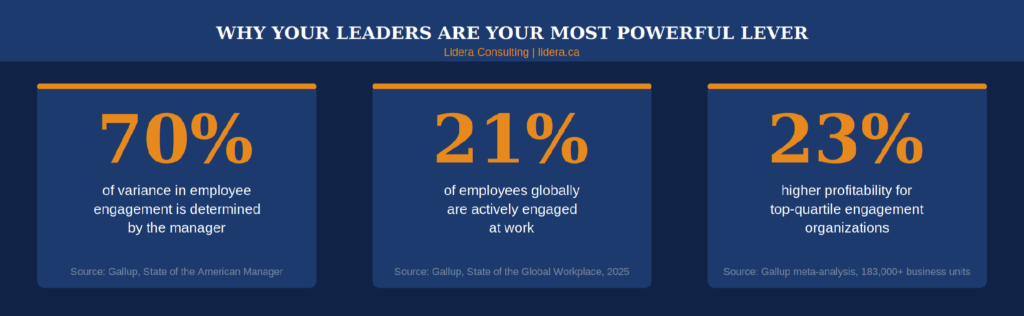
Gallup research, across 27 million employees, shows that managers account for at least 70% of the variance in employee engagement scores. Yet only 21% of employees globally are actively engaged, according to Gallup’s 2025 State of the Global Workplace. The gap between what we know about leadership’s impact and what most organizations invest in developing it comes down to program design.
A leadership development program is worth designing properly. Here is how to do it.
What Is a Leadership Development Program?
The distinction between a workshop and a program matters, because the two require fundamentally different designs.
A leadership training workshop is a bounded event, typically one to two days, that delivers relevant knowledge and introduces specific skills. A leadership development program is a structured, multi-month experience designed to change how leaders operate in their day-to-day work. It typically runs six to twelve months and operates on three tracks simultaneously:
- Track 1: Group learning. Workshops, cohort sessions, and peer learning that build shared skills and language.
- Track 2: Individual development. Self-assessment, coaching, and personal development planning.
- Track 3: Organizational integration. Sponsor involvement, manager reinforcement, and alignment to performance systems.
Most interventions labeled “leadership programs” address only Track 1. Group learning without individual development produces group insight but often without individual behavior change. Even when a leader (participant) likes the content and intends to apply new skills, they leave the workshop to an inbox full of emails, a line up of team members with questions, and their own work to deliver on. The new ideas and skills from the workshop quickly fade away.
All three tracks together are what produces real behavior change and organizational change.
All three tracks together are what produces real behavior change and organizational change.
| Dimension | Workshop | Leadership Development Program |
|---|---|---|
| Duration | 1 to 2 days | 6 to 12+ months |
| Structure | Single event | Multi-phase, multi-track system |
| Assessment | Usually none | Baseline and exit 360 or behavioral diagnostic |
| Individual support | Rarely included | 1:1 or group Coaching built into the program. Individuals direct manager is involved |
| Organizational integration | Manager briefing, if any | Ongoing sponsor involvement, specific work based assignments, performance alignment |
| Measurement | Satisfaction survey | Behavioral change at 60 days, business metrics at 12 months |
Your leaders are the single biggest variable in your engagement results. Source: Gallup.
Phase 1: Build the Strategic Foundation
Build the business case before designing the program
A leadership development program should connect directly to a specific organizational challenge or need. Not “we want better leaders” but: “our people managers are not having regular development conversations with their teams” or “our engagement survey shows that the top driver of voluntary turnover is employees feeling disconnected from the organization.”
Gallup’s meta-analysis across more than 183,000 business units shows that top-quartile engagement organizations achieve 23% higher profitability than those in the bottom quartile. When you can tie that number to a specific leadership gap in your organization, the investment conversation changes.
Secure genuine executive sponsorship
Before a single session is designed, someone in a position of real authority needs to be personally committed to this program, not just signed off on the budget.
Genuine sponsorship means the sponsor opens the first session and describes what they are personally working on as a leader. Their name appears in the pre-program communication, not just in an HR email. They have a direct conversation with participants’ managers about reinforcing the skills being developed. And they are available for a check-in partway through the program.
Without this, the program competes with every other organizational priority. With it, the program shifts from “something HR is running” to “something the organization is taking seriously.”
Select participants with intention
Participant selection is a strategic question, not a logistical one. Effective programs typically target one of three groups: frontline managers with the most direct impact on team engagement, high-potential leaders being developed for broader responsibility, or a cross-functional cohort sharing a specific leadership challenge. Clarify the target group and the behavior change you want to see, before designing anything.
Phase 2: Establish a Baseline Before Anyone Attends a Workshop
One of the most consistently skipped steps in program design is the baseline assessment. Organizations launch into training without a clear picture of where participants are starting from, which means they have no way to measure what changed. This doesn’t have to take long.
Start with self-awareness
Dr. Tasha Eurich, an organizational psychologist, has found that 95% of people believe they are self-aware, while rigorous assessment suggests only 10 to 15% actually are. The gap between how leaders see themselves and how others experience them is one of the most reliable predictors of development need.

A baseline does not require a lengthy instrument. A well-designed behavioral 360, a structured self-assessment tied to your target behaviors, or a facilitated peer feedback session at program launch gives participants a clear picture of their starting point.
Phase 3: Design the Overall Program Structure
As we mentioned above, while a good 1 or 2-day workshop can provide valuable knowledge, new knowledge is usually not enough on its own, to create behavior change. You may have heard of the 70-20–10 rule whose ‘term’ has become popular over the last 10 years. It suggests that an effective program shifts the emphasis to focus more on work-based assignments and projects (applying the learning) in addition to just training. For example:
- 70% work-based assignments and experiences.
- such as coaching a team member using the new skills.
- 20% developmental relationships
- Creating small cross department learning cohorts or pods.
- 10% coursework and training
- Instructor lead learning, self-directed learning on new knowledge and skills.
As an example, imagine asking your leaders to take an online course to learn about A.I., and then ‘hope’ they apply it, versus having them take the course, then work in small groups to apply the key learnings from the AI course, to an actual process or project at work.
Phase 4: Design the Group Learning Track
The group learning track should be grounded in the behavior gaps identified in your needs assessment and the baseline data from Phase 2. Its design must prioritize deliberate practice over passive learning. What knowledge and skills do the leaders need, to create the desired results?
The core skill-building intervention
Research from Anders Ericsson, published in Peak, establishes that lasting behavior change requires structured practice with immediate expert feedback. A workshop that delivers concepts and facilitates discussion but never asks participants to actually attempt the skill will likely not produce behavior change.
An effective group learning intervention includes:
- Clear target behaviors, defined specifically enough to practice and receive concrete feedback on
- Modeled demonstration showing the behavior done well
- Structured practice attempts in realistic scenarios drawn from situations participants actually face
- Specific behavioral feedback in real time from a skilled facilitator
- A second attempt incorporating the feedback, where the improvement makes the shift feel real
- Between-session assignments that give participants a specific situation to try the skill in before the next cohort touchpoint
Lidera’s Coaching for Engagement workshop is designed around this model. The program focuses on how leaders inspire higher performance and increase engagement in their teams, using evidence-based strategies grounded in the neuroscience of motivation. It is available as a 1-day workshop, a 2-day deep-dive (the most popular format), or a webinar series for distributed teams. As part of the design, participants work in pods and complete 4 specific practicums applying the skills with their teams at work. All formats include a 30-minute 1:1 coaching session with a certified coach following the workshop.
Structure peer learning between formal sessions

Peer learning circles of four to six participants, meeting for 45 to 60 minutes between cohort sessions, maintain social accountability and surface the real implementation challenges the next facilitator-led session can address.
A simple structure works best. Each participant shares one situation where they tried a target skill since the last session, what happened, and where they got stuck. The group responds with questions rather than advice. This format is low-facilitation and produces more insight per hour than almost any other program component. They can also use this time to practice a skill in this safe setting.
Phase 5: Build the Individual Development Track
The individual development track addresses what no group session can: the specific circumstances, challenges, and growth edges of each individual participant.
A publication from the Chief Learning Officer journal found that programs combining group learning, executive coaching, and experiential application activities consistently outperform programs relying on group learning alone. The coaching component provides the individualized feedback loop that makes group learning stick.
This can be an external coach, the expert facilitator, or if the budget is tight, an internal subject matter expert who can provide meaningful feedback and ideas. Matching coaching depth to program goals
Not every participant needs the same coaching investment. A useful framework is three tiers:
| Tier | Right for | Lidera program |
|---|---|---|
| Post-workshop coaching | Participants who need support applying specific workshop skills | i.e.60-minute 1:1 session included with all Coaching for Engagement formats |
| Short-cycle coaching | Participants navigating a specific leadership challenge or transition | i.e. Advance (3-month, CA$3,000): 6 sessions over 3 months |
| Sustained coaching | High-potential leaders, significant role transitions, or deeper personal development | i.e. Re-Ignite (6-month, CA$6,500) or Breakthrough (12-month, CA$9,500): includes leadership strategy components |
The coaching in the Re-Ignite and Breakthrough programs are an example of providing sustained learning over time, focusing on personal clarity, and the knowledge, skills, and mindsets that underpin sustained leadership effectiveness. This is the “lead yourself first” principle at the center of Lidera’s approach: you cannot lead others consistently well from a depleted or unmotivated place.
Phase 6: Build the Organizational Integration Track
The manager as an active development partner
Brief the managers of your program participants before the program starts, not just to inform them but to enlist them. Give each manager a one-page summary of the three target behaviors being developed, what to look for, and one practical way to reinforce each behavior in their regular interactions with the participant.
Without this, participants return to the same environmental pressures that produced the original behaviors, now with new skills they have no opportunity to use.
Align to performance conversations
One of the highest-leverage moves is aligning the program’s target behaviors to the organization’s existing performance review language. If a leader knows that demonstrating the behaviors they are learning will be noticed and valued in their next performance conversation, the program becomes intrinsically motivated. This alignment requires a conversation between the program sponsor and HR before the program launches.
Build peer accountability structures that outlast the program
Peer accountability pairs, matched during the program and briefed on a simple weekly check-in structure, can maintain momentum for 90 days or more after the final session. The check-in is one question: “What did you try this week? What happened?”
Phase 7: Measure What Actually Changed
Most programs measure participant satisfaction. A well-designed program measures behavior change and business outcomes.
- Before the program: Baseline 360 assessment or behavioral diagnostic, tied to the target behaviors from your needs assessment. Again, it doesn’t have to be expensive.
- At 60 days post-program: Brief behavioral survey to each participant’s manager and two direct reports, asking whether they have observed changes in three to five specific behaviors. Qualitative examples are more useful than ratings.
- At 12 months: Exit 360 compared to baseline. Business metrics tied to the original program rationale: team engagement scores, voluntary turnover, customer satisfaction, performance ratings across the cohort.
Presenting results to senior leadership in the language of business outcomes transforms the conversation from “did people like it?” to “what changed, and what was it worth?”
What a 12-Month Program Looks Like in Practice
Here is a concrete example of how these phases come together for a mid-sized organization running a program for 16 frontline managers across two business units.
Months 1 to 2: Foundation
The HR leader and program sponsor agree on the business case: voluntary turnover in customer-facing teams is running above benchmark, and exit interviews name manager quality as the primary driver. The sponsor records a short video for participants. A behavioral needs assessment is run across 12 interviews. Three target behaviors are defined. Participant selection is finalized.
Months 2 to 3: Assessment
The cohort completes a baseline 360 assessment. The What Motivates Me workshop runs as a half-day program launch session. Each participant identifies their top two development priorities. Eight of the 16 participants enroll in the Advance coaching program for ongoing individual support.
Months 3 to 7: Core Learning
The Coaching for Engagement 2-day workshop is delivered in month 4. The What About Me personal resilience 1-day runs in month 5. Between months 4 and 7, the cohort meets monthly in peer learning circles. Each workshop participant completes their included 30-minute 1:1 coaching session in the two weeks following the workshop.
Months 7 to 11: Application
Peer accountability pairs transition to weekly check-ins. Managers have been briefed and are actively looking for the target behaviors. The eight participants in Advance coaching continue their sessions. The program sponsor holds two open-door drop-ins for cohort members.
Month 12: Evaluation
Exit 360 is administered and compared to baseline. Voluntary turnover data for the cohort’s teams is reviewed. The program sponsor presents a one-page summary to senior leadership: what the behaviors were, what the 360 data shows changed, and what happened to the voluntary turnover metric over the 12 months.
This is a real program structure, not a perfect one. The architecture, three tracks in parallel with assessment at entry and exit, deliberate practice in the workshops, coaching at the individual level, and organizational reinforcement throughout, is what separates a program from an event.
Frequently Asked Questions
What is the minimum length for a meaningful leadership development program?
Six months is a reasonable minimum for observable behavior change at the individual level. Twelve months is more realistic for sustainable change that shows up in team-level metrics. Programs shorter than six months can produce useful workshops and insights but are unlikely to produce the organizational behavior change that justifies a full program design investment.
Do you need a 360 assessment to run a leadership development program?
A formal 360 is valuable but not mandatory. What is mandatory is a baseline: a clear picture of where participants are starting from, against which you can measure change. This could be a structured self-assessment, facilitated peer feedback, or behavioral observations from managers.
What is the difference between a workshop, a training program, and an LDP?
A workshop is a bounded skill-building event, typically one to two days. A training program is a series of workshops with a connecting curriculum. A leadership development program is a multi-month system addressing group learning, individual development, and organizational integration simultaneously, with assessment at entry and exit.
How do you get senior leadership to invest in a full LDP vs. a workshop?
Tie the program to a specific business problem with a measurable outcome. “Voluntary turnover in our frontline manager population is 14% above benchmark, costing an estimated $X per departure” creates investment urgency. “We want better leaders” does not.
It never hurts to remind senior leaders of the impact their behaviors have on others and the power of them being seen as sponsors and champions of the leadership program.
How should Lidera’s programs fit into a broader leadership development program?
Coaching for Engagement serves as the core skill-building intervention in the group learning track. What Motivates Me and the Personal Resilience programs are examples of what can serve as self-awareness and personal development modules. The Advance, Re-Ignite, and Breakthrough coaching programs provide the individual development track.
What makes Lidera’s approach different?
Two things consistently: the deliberate practice model, where participants actually practice target skills and receive specific behavioral feedback rather than just learning about them; and the dual focus on leading self and leading others, addressing personal resilience alongside team leadership skills. Again, every concept, skill, and mindset in Lidera’s programs are research-based, easy to use, and proven to get results.
| Ready to design a program that actually changes behavior? Schedule a free 30-minute conversation at lidera.ca/contact matt@lidera.ca | 1.778.888.5902 | lidera.ca |
Matt MacEachern is a Leadership Expert, Organizational Development Consultant, and Certified Professional Coach with over 25 years of experience developing leaders at Oracle, RBC, TELUS, BC Hydro, GroupHEALTH, BCLC, and organizations across Canada. He holds a Master’s degree in Leadership and founded Lidera Consulting Ltd. (lidera.ca) in Vancouver, BC.
Recent Comments